

How to Give and Receive Compliments in English at Work
Master polite phrases, natural responses, and cultural tips for more confident workplace communication.
Giving someone a compliment can “make their day”—in other words, it can lift their mood, boost their confidence, and even strengthen your relationship. So why don’t people give more compliments?
Research shows that we often underestimate how good our compliments make others feel—and overestimate how awkward or uncomfortable they’ll be. In reality, compliments are received far more positively than we think. And when we give them, we usually feel better too.
In this post, you’ll learn how to confidently give compliments in English and how to respond when someone compliments you. You’ll explore a short video, a quick-read article, real-world dialogues, everyday idioms, and a quiz—all designed to help you turn awkward moments into confident conversations and make kindness part of your business English toolkit.
How to Give (and Receive) Great Compliments in English: 7 Easy Tips for ESL Learners
✅ 1. Be Specific
Don’t just say “Good job.” Add a little detail. Highlight specific qualities or actions. This shows the person exactly what you appreciated and makes your words feel more thoughtful.
Try this:
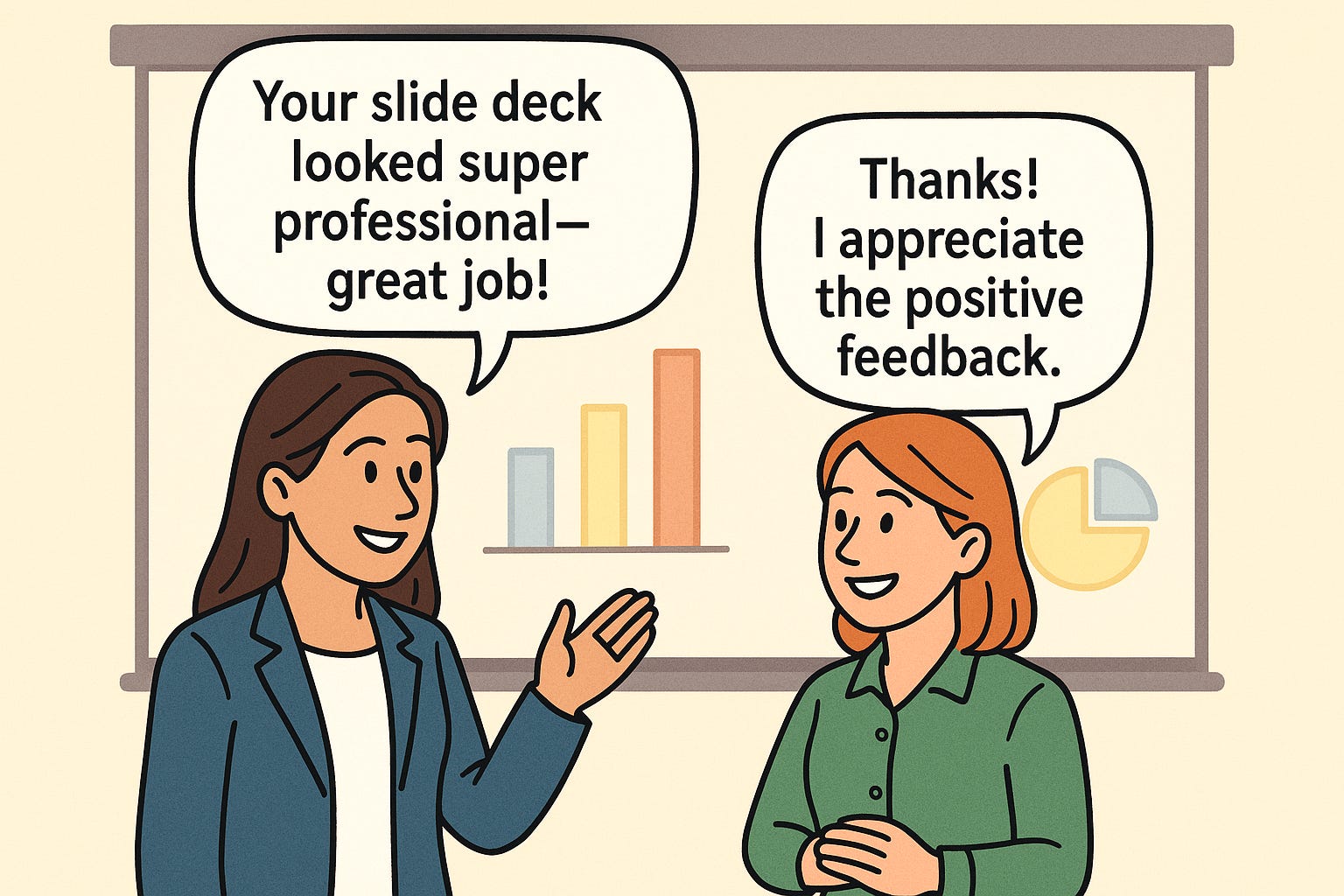
“You explained that clearly. Your slide with the chart was very helpful.”
“Your presentation really inspired me to try a new approach.”
“You kept the group on track during our meeting. I really appreciate your leadership.”
Why it works: Specific compliments feel more sincere and meaningful.
✅ 2. Give Compliments More Often
Many people “hold back” (don’t do something, in this case give a compliment!) because they’re worried about sounding awkward. But research shows most of us give too few compliments, not too many.
Try this:
If you’re thinking something nice—say it!
Compliment coworkers, classmates, even strangers.
Examples:
“You always ask great questions in meetings!”
“You have a great eye for design. Your presentation slides look amazing!”
“Thank you for bringing cookies to the office. They were delicious!”
Note: small compliments count too. They don’t have to be deep or serious.
“Nice note on your email—made me smile.”
“I always enjoy working with you.”
✅ 3. Respect the Context
Compliments should match the situation. At work or school, it’s best to focus on someone’s effort, skills, or contributions—not their appearance. In professional settings, the wrong kind of compliment can feel uncomfortable or even disrespectful.
Try this:
“I’m really impressed by how you handled that tough client call.”
“You explained that process so clearly. I finally understand it!”
❌ Avoid saying things like:
“You looked great giving that report.”
“You’re better than our last intern.”
Also avoid backhanded compliments (compliments that secretly include criticism), like:
“You’re smarter than you look.”
“You did pretty well—for someone new.”
Why it works: Respectful compliments show appreciation for what really matters in a professional or academic setting. They build trust—and avoid making others feel uncomfortable or judged.
✅ 4. Practice if You Feel Nervous
If compliments don’t come naturally, that’s OK. Practice makes perfect!
Try this:
Write the compliment down first.
Say it out loud to yourself or even to your pet!
Use the mirror if it helps you feel more confident.
✅ 5. Say “Thank You” When You Get a Compliment
Don’t reject praise. Even if you feel shy, just smile and say something simple.
Try this:
“Thank you!” (Yes, you can keep it that simple! 😉)
“Thanks! I appreciate that.”
“Thank you—that means a lot.”
Remember: Accepting a compliment helps build connection, and makes the other person feel good too!
✅ 6. Be Genuine
Compliments should be honest. Don’t say something just to impress someone or get something in return. Only give a compliment if you truly mean it.
Try this:
✅ “You’re always so organized—I really enjoy working with you.”
✅ “That was a smart solution to the problem. Great thinking!”
❌ “You’re the best employee in the whole company!” (if you don’t believe it)
❌ “I love your idea!” (but then ignore or criticize it later)
Why it works:
People can sense when compliments are fake or exaggerated. Being genuine builds trust and makes your words more meaningful.
✅ 7. Highlight Growth or Effort
Don’t only compliment results. Notice people’s hard work and progress. Compliments like this show that you're paying attention and that you value improvement.
Try this:
✅ “I’ve seen how much more confident you are in meetings. Great job!”
✅ “You’ve been practicing your English a lot lately. It really shows.”
Why it works:
Praising effort encourages people to keep learning and growing. It feels supportive and respectful—and it’s especially motivating in the workplace or classroom.
💬 How to Respond to Compliments
Many people—even native English speakers—feel awkward when they receive a compliment. They might deflect it (“Oh, it was nothing”) or avoid it completely by changing the subject. But deflecting a compliment can actually make the other person feel uncomfortable or dismissed.
Instead, it’s better to accept a compliment graciously with a simple “thank you.” According to social psychologists Erica Boothby and Vanessa Bohns, accepting compliments and kind words can help build connection—and make both people feel happier after the exchange.
In fact, research by Professors Boothby and Bohns shows that when we give compliments (or other small acts of kindness), we often underestimate how much it means to the other person. Givers think it’s “no big deal,” but receivers feel genuinely good. This “misunderstanding” can stop us from giving kind words more often—and that’s a missed chance to brighten someone’s day and our own.
💬 Sample Dialogues
At Work
Colleague 1: “Nice job on the report!”
Colleague 2: “Thanks! I worked hard on keeping it short and useful.”
In Class
Student 1: “Your presentation was great. You explained everything so clearly.”
Student 2: “Thanks so much! I’m glad it made sense.”
With a Stranger
Person: “I love your bag!”
You: “Thanks! I got it on my trip to Italy last month.”
Team Project Setting
Teammate: “You really helped keep us organized—thanks for that.”
You: “I’m happy it helped! I like making sure we stay on track.”
After a Talk or Performance
Audience Member: “Your talk was so inspiring!”
Speaker: “Thank you! That means a lot.”
💬 Dialogue with Compliments and Idioms
This conversation is full of workplace compliments—and useful idioms!
Instructions:
Read the dialogue aloud to get comfortable with the flow of spoken English.
Notice the idioms in bold.
Check the list of idiom definitions below the dialogue.
Reread the conversation now that you understand the expressions.
Then, take the quiz to test what you’ve learned!
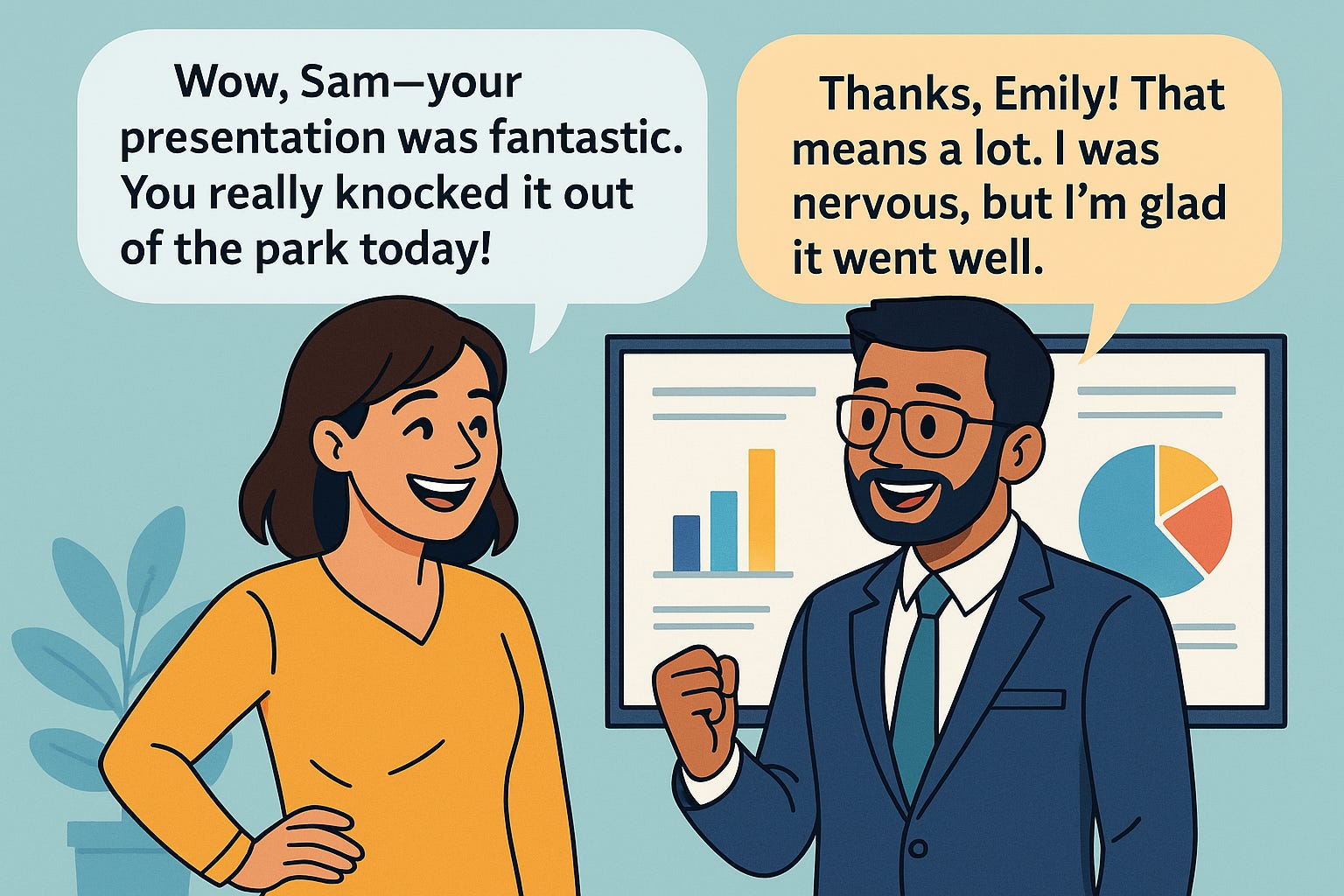
Setting: After a team presentation at work. Colleagues Emily and Sam are talking.
Emily: Wow, Sam—your presentation was fantastic. You really knocked it out of the park today!
Sam: Thanks, Emily! That means a lot. I was nervous, but I’m glad it went well.
Emily: Honestly, your opening totally nailed it. You had everyone’s attention right away.
Sam: I appreciate that feedback. And you handled the Q&A like a pro. Shoutout for staying calm and giving clear answers, even when the questions got tricky.
Emily: What can I say? Years of practice and plenty of coffee!
Sam: [laughs] Well, you made it look easy—seriously. You were such a pro up there.
Emily: Okay, now you’re going to make my day!
Sam: You earned it. And thanks for going the extra mile with the data slides. Those visuals made everything clearer.
Emily: Teamwork, my friend. Let’s give credit where credit is due—we really pulled it off together.
Sam: Agreed. We both deserve a pat on the back!
📘 Idioms
(to) knock it out of the park – Do something extremely well
(to) nail it – Do something exactly right or successfully
(to) go the extra mile – Do more than what is expected
(to) give a shoutout – Publicly praise or recognize someone
(to be) a class act – Be professional, kind, or admirable
(to) make it look easy – Do something difficult with apparent ease
(to) make someone’s day – Make someone feel happy or appreciated
(to give) a pat on the back – Offer praise for a job well done
(to) give credit where credit is due – Acknowledge someone’s contribution or achievement
(to) pull something off – Succeed in doing something difficult or impressive
✏️ Fill-in-the-Blank Idiom Quiz
Instructions: Fill in the blank with the correct idiom from the word bank. You may need to adjust the form slightly to fit the sentence, such as putting the verb in the past tense.
Word Bank
(make my day, go the extra mile, class act, shoutout, nail it, knock it out of the park, give credit where credit is due, pull it off)
Everyone thought the project would fail, but somehow Amira managed to _____.
Let’s give a _____ to Diego for fixing the bug just before the deadline.
Nina, your summary was clear and convincing. You really _____ with that presentation.
Leo always _____ when we’re under pressure. He even stayed late to help the team finish.
I have to say, Olivia, you handled the difficult conversation like a true _____.
I wasn’t having a great day, but Ravi’s compliment really _____.
The marketing team didn’t just do well, they totally _____ with their new campaign.
We should _____. Sasha came up with the idea and led the project from start to finish.
✅ Answer Key
pull it off
shoutout
nailed it
goes the extra mile
class act
made my day
knocked it out of the park
give credit where credit is due
🌍 5 Things You Should Know About Compliments in American Culture
Understanding how compliments work in the U.S. workplace can help you avoid confusion … and build stronger professional relationships. Here’s what you should know:
1. Compliments Are Expected—Especially at Work
In the USA, compliments aren’t just nice—they’re normal. People often grow up receiving praise in school and carry this into adulthood. So if you don’t give compliments, coworkers or students might assume something is wrong. In American culture, compliments are often used to recognize performance, motivate teams, and build morale. Silence may be read as disapproval, even if that’s not your intent!
This reflects the U.S.'s low Power Distance (from Geert Hofstede’s 6 Dimensions of National Culture), where people are more comfortable exchanging feedback openly across roles.
2. Compliments Are Frequent and Emotionally Expressive
Americans tend to praise freely, whether it’s a coworker’s smart idea or a stranger’s stylish shoes. That might feel excessive if you come from a culture where praise is rare or only given privately. But in the U.S., giving compliments is a way to connect—and to make someone’s day a little better.
In more restrained cultures like Germany or Japan, this level of expressiveness might seem strange or insincere. But in the U.S., it’s part of friendly, everyday communication.
3. Focus on Effort, Skills, and Results
Compliments in American workplaces are most effective when they highlight someone’s abilities or contributions. Surface compliments (like “You’re pretty”) may feel awkward or inappropriate—especially across gender or rank. Instead, use praise to recognize meaningful actions or results.
4. Compliments Are a Form of Positive Feedback
According to research shared in Harvard Business Review, the brain processes verbal praise similarly to receiving a financial reward. Compliments help people feel valued and seen, which can increase motivation and even improve performance. This is especially true in the U.S., where people often tie their identity to their work.
Don’t underestimate a kind word. A sincere compliment can improve morale, prevent burnout, and support retention.
5. They’re Used to Start Conversations, Too
In American culture, compliments are not just feedback—they’re also small talk. A quick “Great shoes!” or “Love your laptop sticker!” can be a friendly icebreaker. This style of light, upbeat interaction is common in the U.S. and often helps people feel more comfortable in new or casual situations.
Compliments are one way Americans create a warm, approachable atmosphere—even in brief encounters.
🎥 Watch: The Art of Receiving Compliments Graciously
Do you feel awkward when someone gives you a compliment? You’re not alone—and you’re not doing anything wrong. According to etiquette coach Tracy Hensel, many people struggle to accept compliments without deflecting, minimizing, or feeling like they need to return the favor. In this video, she explains why compliments are a gift—one that costs nothing—and how to accept them with confidence and grace, without apologizing or giving something back.
What’s the best compliment you’ve ever received, or given, in English? Leave a comment!
I've never got a real complement in English cuz idont realy know people who know how to speak with English so my wish is to have someone to communicate with using english even thought im not that good on it
the best compliment i ever had is you're intellegent and exceptional. it was from my teacher hhhhhh 💙