

Let's Make a Deal
The language of negotiation in American business

In U.S. workplaces, negotiation isn’t about pushing harder. It’s about saying the same thing in a way the other person can actually respond to. A small shift — from “We need a lower price” to “Would you be open to revisiting the pricing?” — can change how the conversation unfolds.
In this lesson, I’ll show you how negotiation actually sounds in American business settings—and how to use language that keeps the conversation open, productive, and professional.
The best way to understand this is to hear it in a real conversation.
So instead of starting with rules or explanations, let’s start with a dialogue: a negotiation between two professionals. As you read, pay attention not just to what they say, but how they say it.
🧭 How to Use the Dialogue
To get the most out of this section:
1️⃣ Read the dialogue out loud
Don’t worry about understanding every word. Focus on the flow, rhythm, and how the speakers respond to each other. Note that the words in bold are our vocabulary words that are defined below the dialogue.
2️⃣ Review the vocabulary & examples
Look at how each phrase is used. These are the expressions professionals actually use in workplace conversations. The vocabulary for this lesson is in bold in the dialogue and defined below it.
3️⃣ Go back and read the dialogue again
This time, you’ll notice more: tone, nuance, and how the negotiation develops.
4️⃣ Take the quiz
Test your understanding and make the language active.
🎭 Dialogue: Vendor Contract Renewal
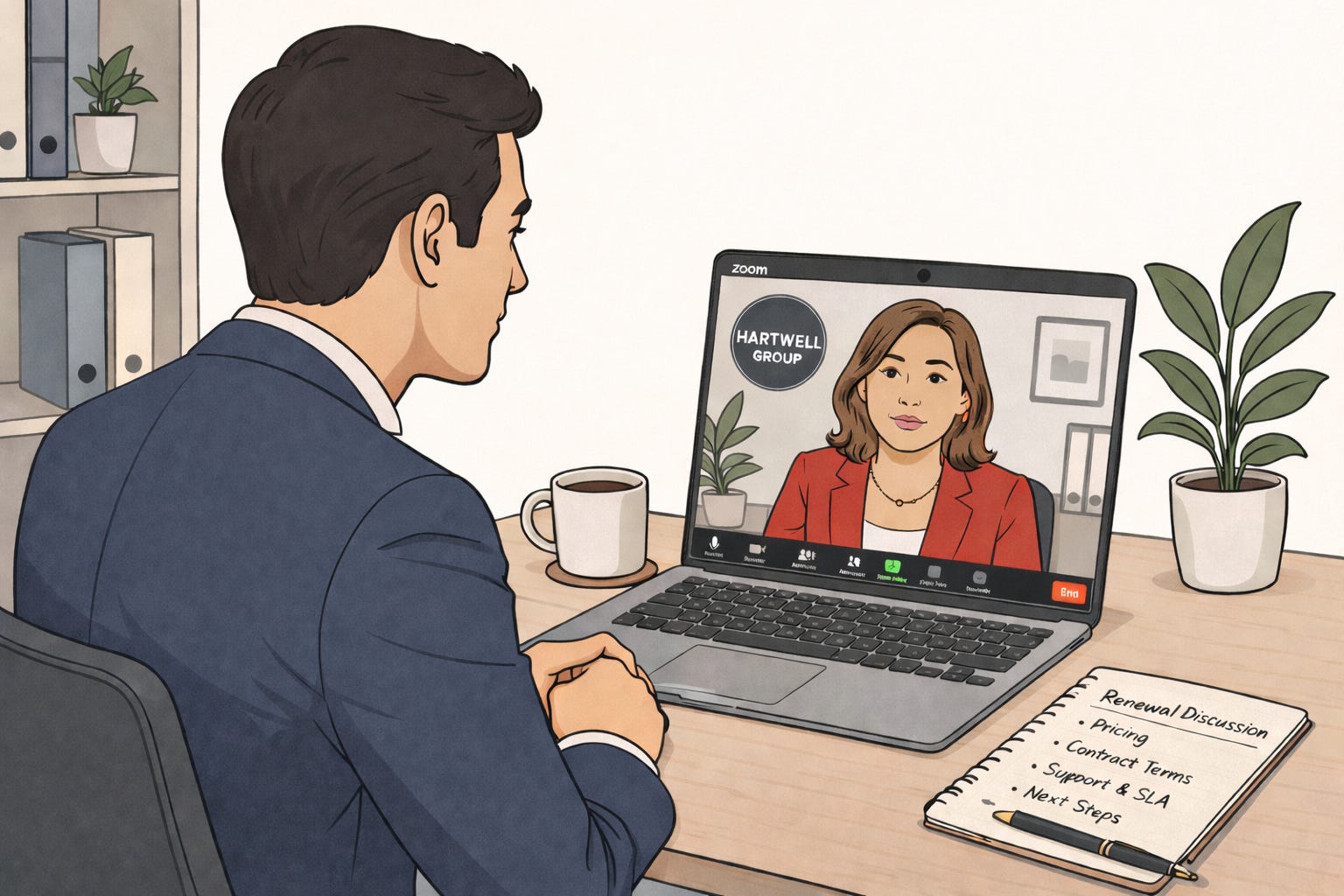
Tom (the sales director at Prism Software) and Lisa (the head of operations at Hartwell Group) are on a Zoom call. For the past year, Hartwell Group has used Prism’s data analytics platform under an annual subscription contract. That contract is now up for renewal.
Tom: Hi Lisa! Good to see you. How’s it going?
Lisa: Good, thanks. I’ve been slammed lately, but I’m glad we carved out some time for this call. How are things on your end?
Tom: Busy! We just launched something I think you’re going to like, which is a nice segue into today’s call.
Lisa: Great, looking forward to hearing about it!
Tom: Well, as you know, our contract is up for renewal next month. To sweeten the deal, we’re adding full access to our new reporting tools at no extra charge. But I do need to be upfront: we’re looking at a 5% increase on the base subscription this year.
Lisa: I appreciate the new tools, Tom. But the price increase is a sticking point. Even 5% is going to be a tough sell to my CFO.* We’ve had other vendors come in with lower numbers, and honestly, I was hoping to bring costs down this year.
Tom: I hear you. What if we meet you halfway? We can hold the rate flat, no increase — and throw in six months of dedicated live support on top of the new tools. That’s a win-win: your costs stay stable and you get a lot more out of the platform.
Lisa: Okay, that may move the needle. But I still need to run this by my CFO before anything is final. She calls the shots on all vendor contracts now — company policy since January.
Tom: Of course. I don’t want to rush you, but our current pricing expires at the end of the month.
Lisa: I’ll have an answer by Thursday. Hold the rate flat, add the tools and the support package, and I think we have a deal.
Tom: You drive a hard bargain, Lisa! Let me send you the updated terms today so you have something to take to her.
Lisa: That sounds good. Thank you.
*CFO (Chief Financial Officer) — the senior executive responsible for managing a company’s finances
📖 VOCABULARY
slammed — extremely busy (informal)
Example: “Can you join the 3 o’clock call?” — “I’m completely slammed today. Can we reschedule?”
to carve out (some) time — to deliberately set aside time for something, even when you are busy
Example: I know you have a lot on your plate, but can you carve out some time this week to review the proposal?
segue (noun/verb) — a smooth, natural transition from one topic or activity to another Pronunciation: SEG-way
Example: After discussing Q1 results, the CEO made a smooth segue into the company's new strategy for the year ahead.
to sweeten the deal — to make an offer more attractive by adding something extra Example: The vendor sweetened the deal by offering six months of free support.
upfront — honest and direct about something from the beginning, without hiding anything
Example: I want to be upfront with you — there will be a small price increase this year, but we're adding significant value to the package.
sticking point — an issue that prevents an agreement from being reached
Example: Delivery time was the main sticking point in our contract negotiations.
a tough sell — something that is difficult to convince someone to accept or agree to
Example: Asking employees to return to the office five days a week will be a tough sell.
to meet someone halfway — to compromise; to accept some of the other side’s terms in exchange for them accepting some of yours
Example: We were far apart on price at first, but we both met each other halfway and finally reached an agreement.
on top of — in addition to; as well as something else
Example: We're offering six months of free support on top of the standard package — at no extra charge.
win-win — a situation or outcome that is good for everyone involved
Example: Letting employees work from home two days a week is a win-win — staff are happier and the company saves on office space.
to move the needle — to make a noticeable difference or meaningful progress on something
Example: We've tried several marketing campaigns, but nothing has really moved the needle on sales this quarter.
to run something by someone — to ask for someone’s approval or opinion before deciding
Example: Before we sign this agreement, I need to run it by our legal team.
to call the shots — to make the important decisions; to be in charge
Example: After the merger, it wasn’t clear who would call the shots at the new company.
to drive a hard bargain — to negotiate very firmly and refuse to accept unfavorable terms
Example: Our supplier drives a hard bargain — it took three rounds of talks before we agreed on a price.
🧠 Quick Quiz: What Did You Understand?
If you understood this conversation, you’re already thinking like a U.S. professional negotiator. Let’s test that.
1. Why does Tom offer extra features during the renewal discussion?
a) Because Lisa asked for them
b) To offset a price increase
c) Because they’re included in the standard package
2. What is Lisa’s main concern about renewing?
a) The new reporting tools aren’t useful
b) The contract deadline is too soon
c) The price increase will be hard to justify to her CFO
3. What does Tom offer to do to reach an agreement?
a) Lower the price by 5%
b) Hold the rate flat and add support and tools
c) Extend the contract deadline by a month
4. Why does Tom say “I don’t want to rush you, but…”?
a) He wants to end the conversation quickly
b) He is applying subtle pressure while staying polite
c) He is unsure about the offer
✅ Answer Key
1️⃣ b) To offset a price increase
2️⃣ c) The price increase will be hard to justify to her CFO
3️⃣ b) Hold the rate flat and add support and tools
4️⃣ b) He is applying subtle pressure while staying polite
Your Turn
Now imagine you’re in Lisa’s position.
Tom has just proposed terms you’re not sure about.
You don’t want to agree too quickly. But you also don’t want to push back too directly.
So what do you say?
🎯 What to Say in This Situation
Instead of responding immediately, try a simple line like:
“Can we talk through that for a minute?”
“Can we take a closer look at that?”
“Can we walk through the details together?”
Then pause — and listen.
🧠 Why this works
Research in negotiation, including the landmark book Getting to Yes, shows that effective negotiators don’t react immediately.
They slow the conversation down to:
Clarify what’s being proposed
Understand the other side’s constraints
Create space to respond strategically
One of the core principles in Getting to Yes is to separate the people from the problem—focusing on the issue itself rather than reacting to the person.
That’s exactly what these phrases do.
They address the situation—not the person.
They keep the tone collaborative, avoid immediate agreement or rejection, and give you time without sounding hesitant or unsure.
🔒 Unlock the Full Lesson
You’ve seen how this language works.
Now it’s your turn to use it—when the stakes are real.
Inside, you’ll step into the negotiation and decide what to say before seeing how experienced professionals respond.
You’ll get:
A negotiation quiz with detailed explanations
Practice that shows what to say—and what to avoid
Cultural insight so you don’t misread the situation
👉 By the end, you’ll know exactly what to say when a client pushes for better terms.
Upgrade to paid: $50/year or $8/month.
Keep reading with a 7-day free trial
Subscribe to Speak Business English Like an American Newsletter to keep reading this post and get 7 days of free access to the full post archives.