

What Native Speakers Actually Mean When They Say…
Decoding the polite language of U.S. workplace English
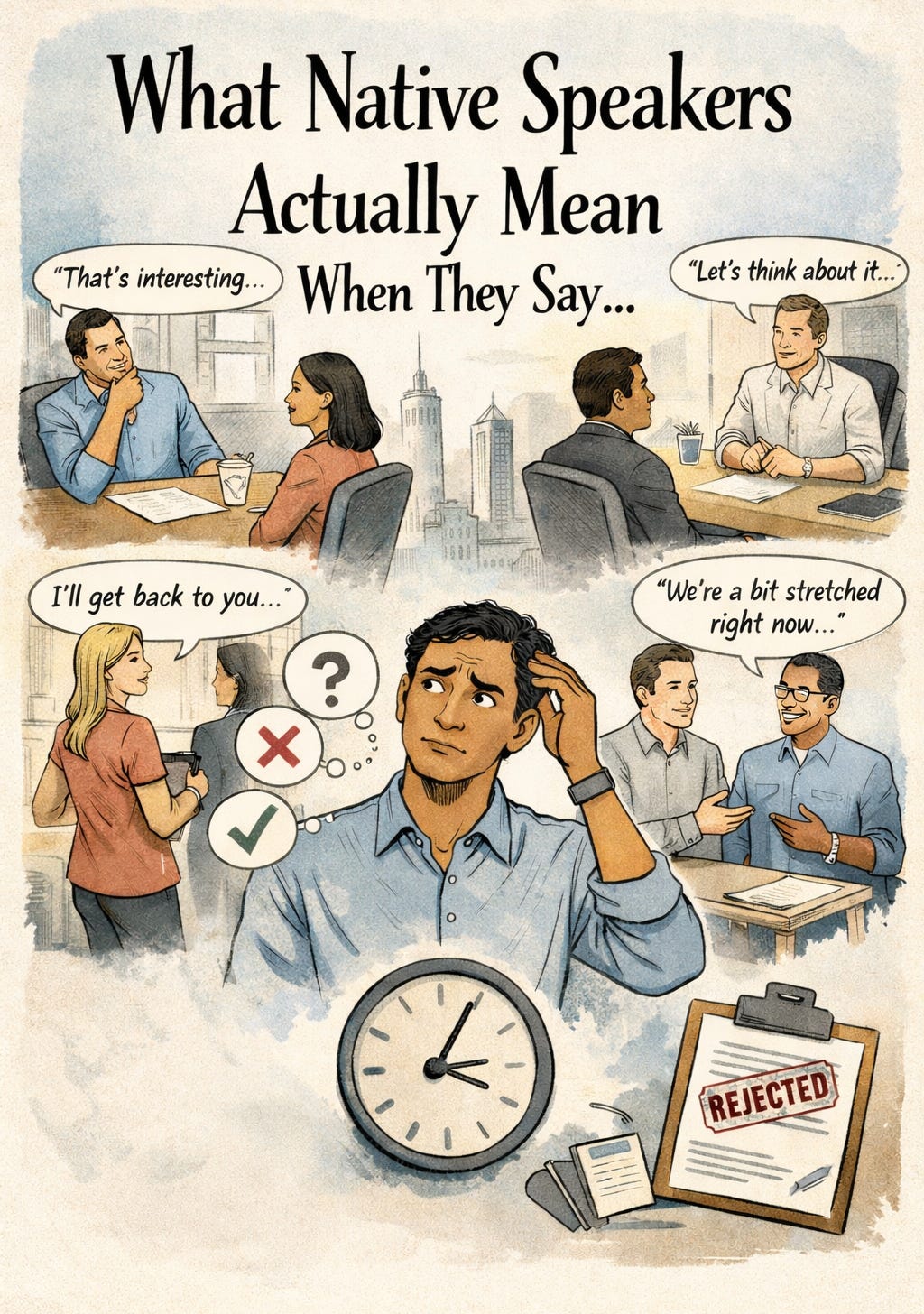
What Native Speakers Actually Mean When They Say…
If you work in English, you’ve probably noticed this: people don’t always say what they mean.
Instead, native speakers use polite, indirect phrases to manage disagreement, delay decisions, protect relationships, or avoid tension.
Below are 10 phrases you’ll hear constantly in U.S. business environments, what they often really mean, and how to interpret them accurately. For each phrase, you’ll see a Use Meter (1–10) that shows how likely you are to hear it when doing business with U.S.-based professionals.
1. “That’s interesting.”
What it often means:
Polite skepticism or disagreement.
Mini-dialogue A (meeting)
You: I think we could simplify onboarding.
Manager: That’s interesting.
(The meeting moves on.)
Mini-dialogue B (client call)
You: We’d recommend a pilot first.
Client: Hmm. That’s interesting.
Use meter:
█████████░ (9/10)
Note:
If it’s followed by a question, interest may be genuine.
If not, it’s usually a soft stop.
2. “Let’s think about it.”
What it often means:
A polite “not right now” — and sometimes a no.
Mini-dialogue A
You: Should we change the approval process?
Director: Let’s think about it.
Director: Next item.
Mini-dialogue B
You: Could we revisit the budget?
Manager: Let’s think about it.
Use meter:
████████░░ (8/10)
Note:
Unless someone actively brings it back, this often goes nowhere.
3. “I’ll get back to you.”
What it often means:
No answer yet — and possibly no clear answer internally.
Mini-dialogue A (email)
You: Can you confirm the deadline?
Reply: I’ll get back to you.
Mini-dialogue B
You: Are we aligned on next steps?
Colleague: I’ll get back to you on that.
Use meter:
█████████░ (9/10)
Note:
Following up politely is expected — not rude.
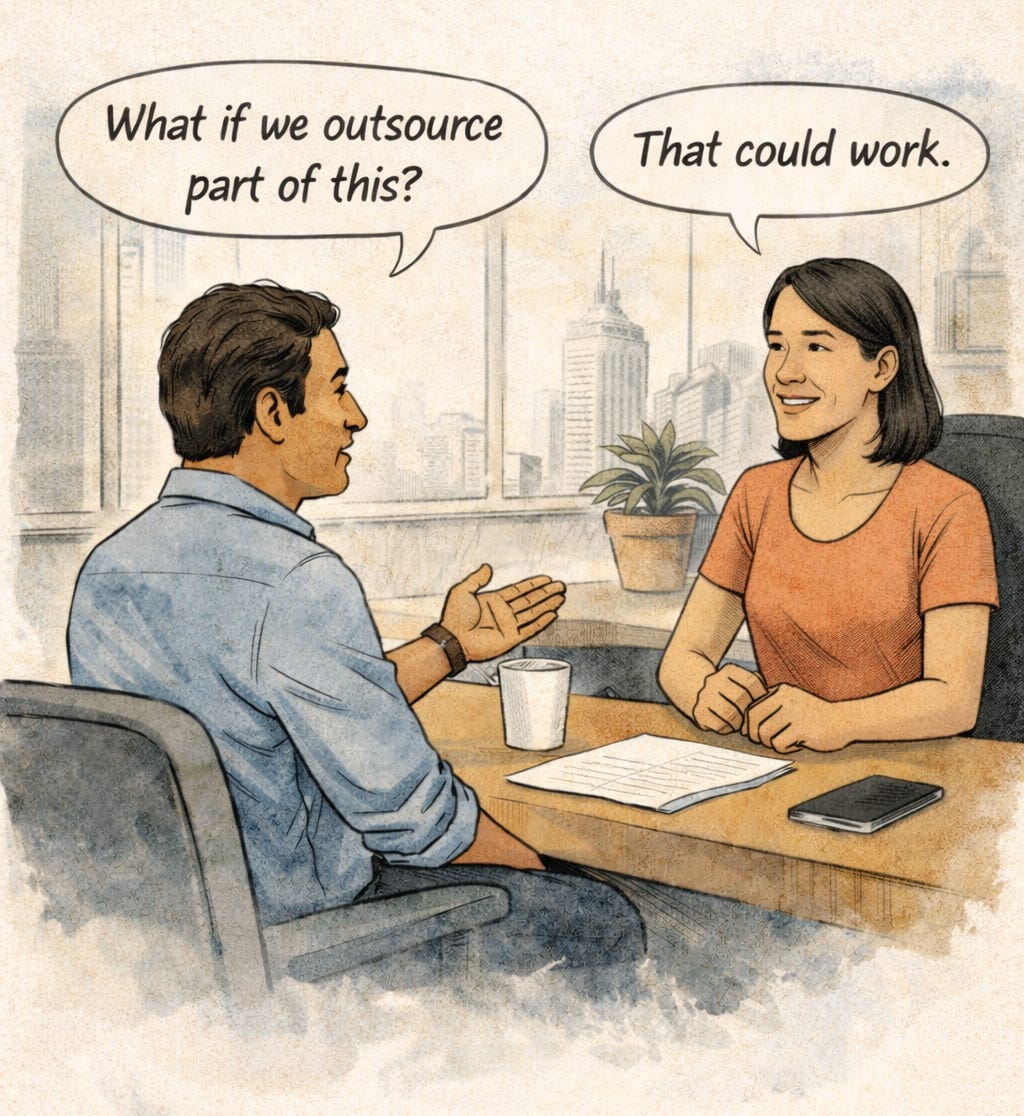
4. “That could work.”
What it often means:
Acceptable, but not the preferred option.
Mini-dialogue A
You: What if we outsource part of this?
Lead: That could work.
Mini-dialogue B
You: We could adjust the scope slightly.
Manager: Yeah… that could work.
Use meter:
████████░░ (8/10)
Note:
Compare with “That works,” which signals stronger approval.
5. “We’re a bit stretched right now.”
What it often means:
This isn’t a priority — regardless of resources.
Mini-dialogue A
You: Could we add another team member?
Manager: We’re a bit stretched right now.
Mini-dialogue B
You: Can we move the deadline up?
Lead: We’re a bit stretched right now.
Use meter:
███████░░░ (7/10)
Note:
This usually isn’t temporary — at least not soon.
6. “Let’s take this offline.”
What it often means:
This conversation doesn’t belong in this room or at this time.
Mini-dialogue A
You: I don’t think the data supports that.
VP: Let’s take this offline.
Mini-dialogue B
You: I’m not sure we agreed on that.
Manager: Let’s take this offline.
Use meter:
███████░░░ (7/10)
Note:
This is usually about tone, politics, or timing — not that you’re wrong.
7. “Thanks for flagging this.”
What it often means:
I see it — but I’m not committing to action.
Mini-dialogue A
You: There may be an issue with the data.
Reply: Thanks for flagging this.
Mini-dialogue B
You: I noticed a delay in approvals.
Manager: Thanks for flagging.
Use meter:
████████░░ (8/10)
Note:
Acknowledgment ≠ resolution.
8. “We’ll circle back.”
What it often means:
Not now — and possibly not ever.
Mini-dialogue A
You: Should we decide today?
Manager: Let’s circle back.
Mini-dialogue B
You: When should we revisit this?
Lead: We’ll circle back.
Use meter:
█████████░ (9/10)
Note:
If no time is mentioned, you’ll need to follow up.
9. “Just to clarify…”
What it often means:
Concern, risk, or disagreement — expressed politely.
Mini-dialogue A
You: So we’ll deliver Friday.
Manager: Just to clarify — end of day?
Mini-dialogue B
You: We’ll proceed with Option A.
Reply: Just to clarify, is legal aligned?
Use meter:
████████░░ (8/10)
Note:
This signals caution, not confusion.
10. “At this stage…”
What it often means:
Expectations are being quietly limited.
Mini-dialogue A
You: Will we expand this next quarter?
Lead: At this stage, we’re focused on the pilot.
Mini-dialogue B
Client: Should we plan a longer engagement?
Account Manager: At this stage, let’s see how Phase One goes.
Use meter:
███████░░░ (7/10)
Note:
This lowers future expectations without saying no.
Mini Cases: Reading Between the Lines in Polite Workplace English
In U.S. professional settings, managers and leaders often soften disagreement, delay decisions, or close off options without saying “no” outright. For people working in English as a second language, this can be confusing — not because the English is difficult, but because the signal is indirect.
The scenarios below are based on real workplace interactions. Each one shows how a well-intentioned, polite response from a U.S. leader can be interpreted very differently by someone from another cultural background.
As you read each case, pause before the explanation. Ask yourself:
What message is the manager or leader actually sending?
What decision (if any) has already been made?
What would a smart, professional follow-up look like?
These cases aren’t about catching mistakes. They’re about learning to read between the lines — and responding in a way that fits U.S. business culture while protecting your own goals and credibility.
Mini Case 1: “That’s Interesting”
The situation
Ana, a senior analyst from Spain, presents a proposal during a strategy meeting with her U.S. manager and several peers.
After she finishes, the manager nods and says:
“That’s interesting. Thanks for putting that together.”
The manager then moves on to the next agenda item.
No questions are asked. No discussion follows.
Ana leaves the meeting feeling cautiously optimistic (note: when you are “cautiously optimistic” you feel hopeful but not fully confident yet). She begins outlining next steps.
Two weeks later, Ana learns the team has decided to move forward with a different approach. “WTH?” thinks Ana (that is short for “what the hell?” as in, what is happening here?).
🧠 What’s going on here?
Pause for a moment. Was this encouragement — or something else?
💡 BEHIND THE SCENES
In U.S. workplace culture, “That’s interesting” is often a polite signal of skepticism, especially in group settings.
The key message wasn’t the phrase itself — it was the lack of engagement afterward.
When U.S. leaders like an idea, they usually probe it immediately.
✅ Savvy follow-up
“I’d love your candid reaction — were there any concerns I should address?”
Mini Case 2: “Let’s Think About It”
The situation
Khaled, an engineer from Egypt, proposes a change to a long-standing internal process during a one-on-one with his U.S. director.
The director listens, pauses briefly, and says:
“Let’s think about it.”
The conversation moves on.
Khaled assumes the idea is under active consideration and waits for feedback.
Several weeks later, he raises the topic again. The director responds:
“We decided to stick with the current process.”
🧠 What’s going on here?
Was this a delay — or a decision?
💡 BEHIND THE SCENES
In U.S. management language, “Let’s think about it” often functions as a soft no.
It allows leaders to avoid shutting down ideas directly while keeping conversations efficient.
Unless the idea is deliberately reintroduced, it often fades.
✅ Savvy follow-up
“Would it be helpful if I put together a brief comparison and checked back next week?”
Mini Case 3: “We’ll Circle Back”
The situation
Lucia, a marketing manager from Italy, asks during a team meeting whether the group needs to decide that day which campaign to prioritize for Q2.
Her U.S. director responds:
“Let’s circle back on that.”
The meeting ends shortly afterward.
Lucia assumes the decision will be revisited soon and waits for a follow-up meeting or email.
Weeks pass. The team quietly begins working on a different campaign.
🧠 What’s going on here?
Was this a postponement — or a quiet decision?
💡 BEHIND THE SCENES
In U.S. leadership culture, “We’ll circle back” often means “not now” — without committing to when or whether the topic will return.
If no timeline is stated, the implicit responsibility to follow up usually shifts to the person who raised the issue.
✅ Savvy follow-up
“Before we move on, should I plan to bring this back at a specific time?”
Want to Go Deeper? Learn More About American Business Culture
Understanding how native speakers signal meaning indirectly is one powerful piece of successful workplace communication in the U.S. — but it’s only part of the picture.
If you’d like a broader cultural context to go with these language insights, check out the American Business Culture section in the English Learning Hub. It’s a practical guide to key aspects of working in the U.S., including:
how Americans communicate at work
email and messaging etiquette
meeting culture and when to speak up
networking and career growth
how small talk and workplace humor work in American teams
👉 Explore the free guide here:
Want More Like This?
If this post helped you read U.S. workplace English more clearly, the premium section goes one step further — it shows you what to do next, not just what something means.
As a paid subscriber, you get:
Bonus content in this post: the full What to Say Next (and When to Stop) playbook for all 10 phrases
Practical follow-up language you can reuse immediately
Access to the entire archive of advanced Business English posts — real workplace scenarios, not textbook lessons
If you work in English and want to communicate with more confidence, clarity, and control, upgrading gives you tools you’ll use again and again.
👉 Become a paid subscriber to unlock this section and the full archive.
